
THE INTERNET, WITHOUT THE HEADACHE
Your address. Your space.
The directions that connect them.
Domains, hosting and DNS can sound like a lot to untangle. Think of them as the address, premises and directory for your online home or business.
Three separate things. One familiar name.
They work together, but you do not have to buy them all from the same place. Here is what each one does.

01 · DOMAIN
Your address.
A domain is the easy-to-remember name people use to find you, such as yourbusiness.com.au.
Like an address on a sign, it tells people what name to use. Registering that name does not create a website or an email mailbox by itself.
You renew its registration to keep using it. With HypeID, domain registration is billed per year.

02 · HOSTING
Your premises.
A website needs somewhere to keep its pages, photos and files. Website hosting provides that space and serves those files to visitors.
Email hosting provides your mailboxes and stores your messages. A domain name alone is not an email service.
Your website and email can be hosted together or with different providers. HypeID hosting is billed monthly.
03 · DNS
Your directory.
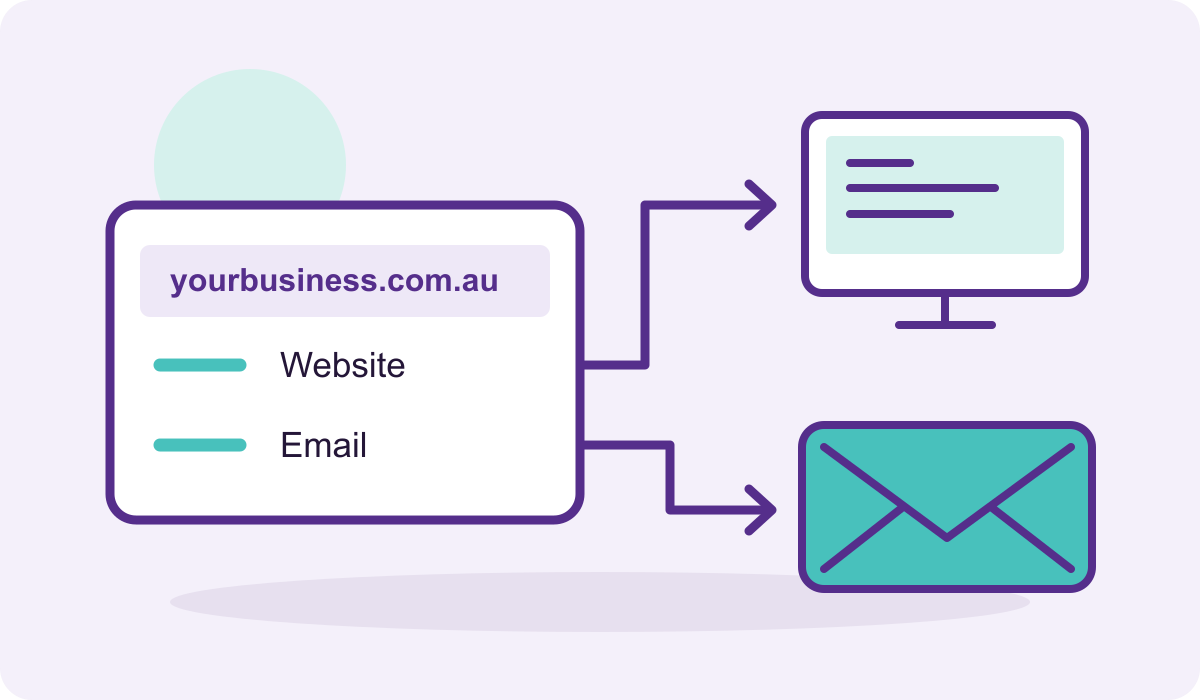
DNS stands for Domain Name System. It is the directory that tells computers where to find the services attached to your domain.
One entry points visitors towards your website. Other entries tell email systems where to deliver your mail.
DNS does not store your website or messages. It provides the directions. Your domain, website and email can be managed by different companies.
And who manages the address?
Your domain registrar is the company that manages your domain registration, renewals and registration details. It does not have to be the company hosting your website or email. Think of it as who looks after the address registration, rather than the premises.
What happens when someone visits your website?
1 · You type the name
You enter yourbusiness.com.au in your browser. You do not need to remember the server’s numerical internet address.
2 · DNS finds the destination
Your device uses DNS to look up where the website lives. It may already have a recently saved copy of the answer.
3 · Your browser connects
Your browser connects to the website’s hosting server and loads the page. DNS supplied the destination; the website itself comes from the host.
Email works with its own DNS instructions. That is why your website can be with one provider while your email stays with another.
The bits that often get mixed up.
Do I need to transfer my domain to change hosting?
Often, no. You can usually keep the registration with your current registrar and update the relevant DNS settings to connect new hosting. You need control of the domain and its DNS settings.
Transferring the registration means changing which registrar manages it. That does not move your website files or email messages by itself, and DNS settings still need to be preserved.
Will changing my website affect my email?
It can if the wrong DNS settings change. Think of the directory as having separate directions for visitors and post: changing one should not accidentally change the other.
Before moving anything, tell us where your current email is hosted. We can check the existing setup with you so the website change accounts for your email. Do not replace nameservers or delete records without checking what they do.
Why are my DNS changes not showing everywhere yet?
Computers and internet providers remember DNS answers for a while. Some are still using an older copy of the directory while others have picked up the new one.
Changes are not always visible everywhere at once. The wait depends on which settings changed and how long the earlier answers were set to be remembered. Repeatedly changing them can make troubleshooting harder.
Does buying a domain include a website or an email address?
Not by itself. Registering a domain gives you the right to use that name for the registration period, subject to the extension’s rules. You still need website hosting and a website for people to visit, or an email service to send and receive messages.
Website design or building a website can also be a separate service from hosting it. We will make clear what your package includes before you pay.
What am I paying for, and what needs renewing?
Domain registration: keeping your chosen name registered. With HypeID this is billed annually.
Hosting: the service that runs your website or mailboxes. HypeID hosting is billed monthly.
Website builds, migrations or other work may be quoted separately. Keep your renewal contact details current: an expired domain can affect both your website and your email.
A little more detail: records and nameservers
DNS records are the individual entries in the directory. You do not need to memorise them, but these are names you may see:
A and AAAA: point a name to a server’s numerical internet address.
CNAME: points one name to another name.
MX: tells other email systems which servers receive your domain’s mail.
TXT: stores information often used to verify ownership or help email systems check whether a sender is authorised.
Nameservers tell the internet which DNS directory holds your domain’s authoritative settings. Changing them can affect several services at once. It is a different job from moving your domain registration or copying your website.
You do not need to become the IT department.
Tell us whether you need a new domain, want to transfer one, or want to keep it where it is. We will help you understand the next steps.
New .com and .net registration packages can continue to checkout. Australian domains, transfers and domains kept elsewhere are reviewed with you before payment.
Already placing an order? Switch back to your order tab to carry on with your existing choices. Or ask us a question.